


To those that don't know me well, I'll let you in on a secret. I have a dark—and often sarcastic—sense of humor. Which is why, last weekend, I had to stifle a laugh as I read the slogan above the entrance to Portal 31 in Lynch, Kentucky: "Safety the first consideration." There was something morbidly funny about it because coal mining, of course, has hardly been described as a safe profession. But there, etched into the concrete well—or portal, in mining parlance—of U.S. Coal's Mine Number 31 halfway up Black Mountain, sits the company's motto, proclaiming that the safety of its workers was its highest priority. I found myself in the area for the Possumfest—read more about Possumfest here—and had heard about Portal 31 for years but never made it to visit. I hadn't realized what I'd been missing, nor did I miss the coincidence of my visit falling on Labor Day weekend. Miners contributed greatly to the labor movement in America and gave their lives for worker protections.
From the time the mine opened in 1917, millions of tons of coal were chiseled out from this mountain and carted through the portal, first by horse- and donkey-pulled carts and later by more mechanical methods. The coal mined from this mountain powered the United States through two world wars and into the early 1960s. Mining operations stopped at this mine around 1963, the same year Lynch began to see a steady population decline, because it had been deemed too deep, confusing, and dangerously full of methane gas.

And yet, more than six decades later, 13 people—14, counting our driver—climbed into carts to take a tour of that coal mine to experience, in some small way, what it might've been like to have worked there all those years ago. The two men in the row behind me were both descended from coal miners; so was the young family who sat in the back. I did not—my family were largely farmers and merchants—but generations on, the memory and work of those immigrants and native Appalachians alike were honored in equal measure, regardless of lineage.
A scale difficult to imagine
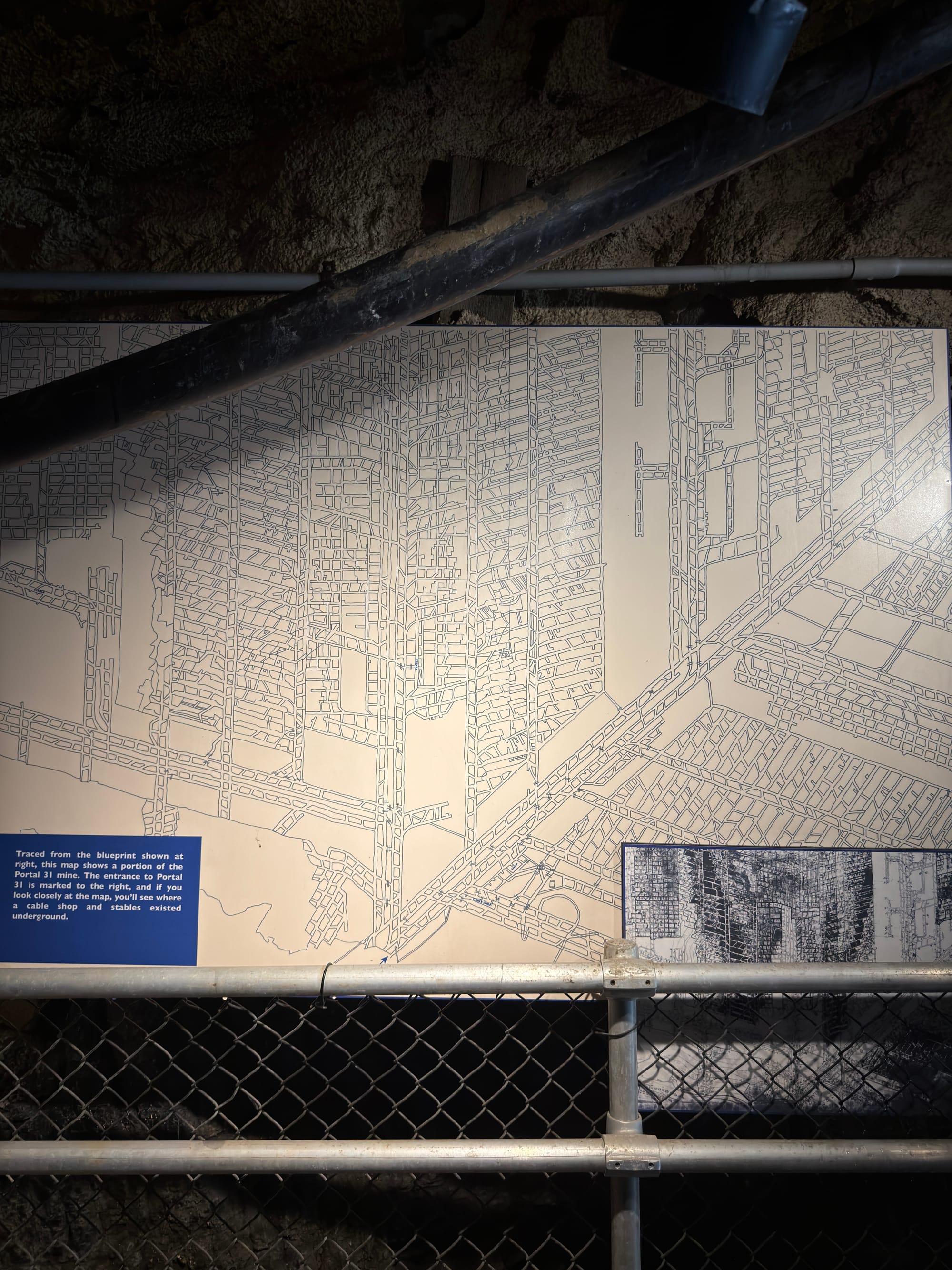
It is still difficult for me to understand, and even harder to convey, the immense scope and scale of this particular mine. A tracing of a blueprint of the mine is on display inside the portal, which is now the start and end point of the mine tour. The intricate web of tunnels and nooks and crannies descends ever deeper into the mountain. One of the many informational signs in the entry hall contains a quote from an unnamed miner:
It changes everyday. It's never the same from one day to the next. There are always challenges. You're under the mountain, and you're going somewhere where no one has ever been every day. It's hard work, but its good work.
Seeing the blueprint helps put what the miners did into perspective: "... you're going somewhere where no one has ever been every day, ..."
The Portal 31 tour
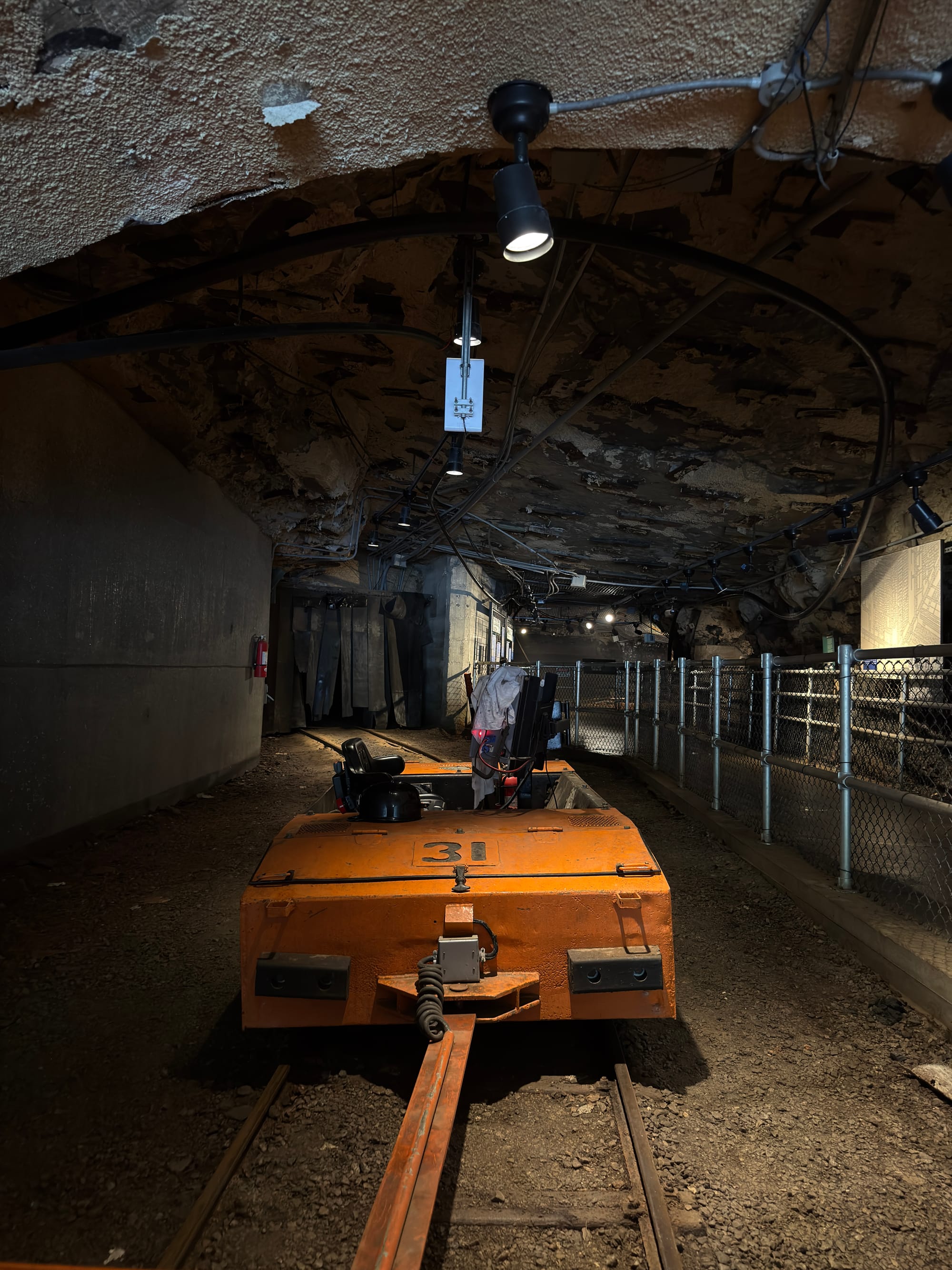
The mine tour was a welcome reprieve from the hot, humid day—it felt like a 40-degree temperature drop just crossing the portal—and the tour, running about 30 minutes from departure to return, covered just under 50 years of mining history. The tour takes you into the mine, barely touching the depths miners of years past ventured into. And it's not for the claustrophobic or those afraid of the dark, either—from my seated position, I felt like I could have touched the roof of the mine without any trouble.
The first stop reminded tour-goers that miners came from Appalachia, yes, but immigrants to the United States also came to towns like Lynch to work in the mines. An Italian immigrant, brought to life by an animatronic, described working alongside people from more than 30 countries who once lived in the little town of Lynch, named for a former head of U.S. Steel.
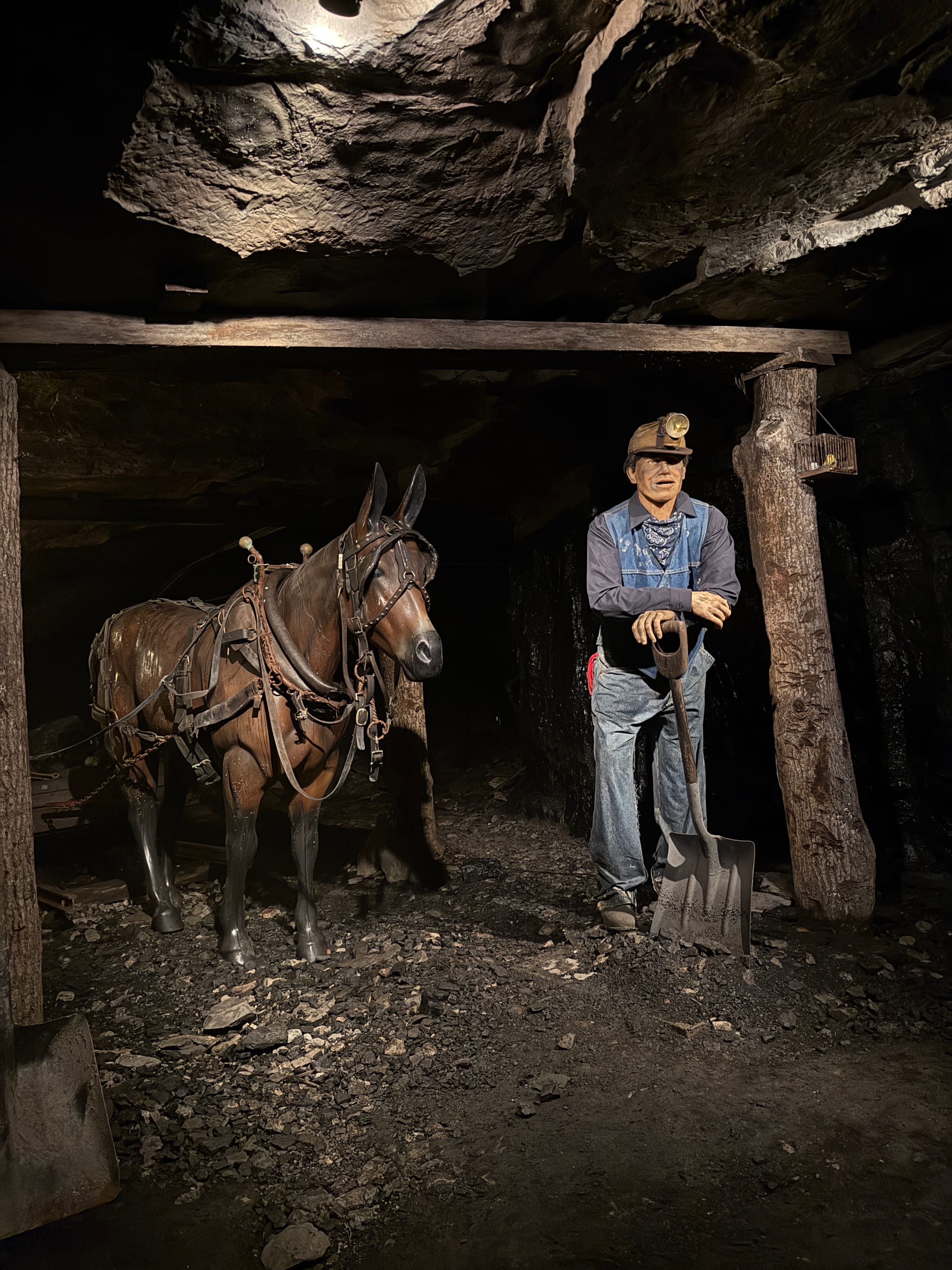
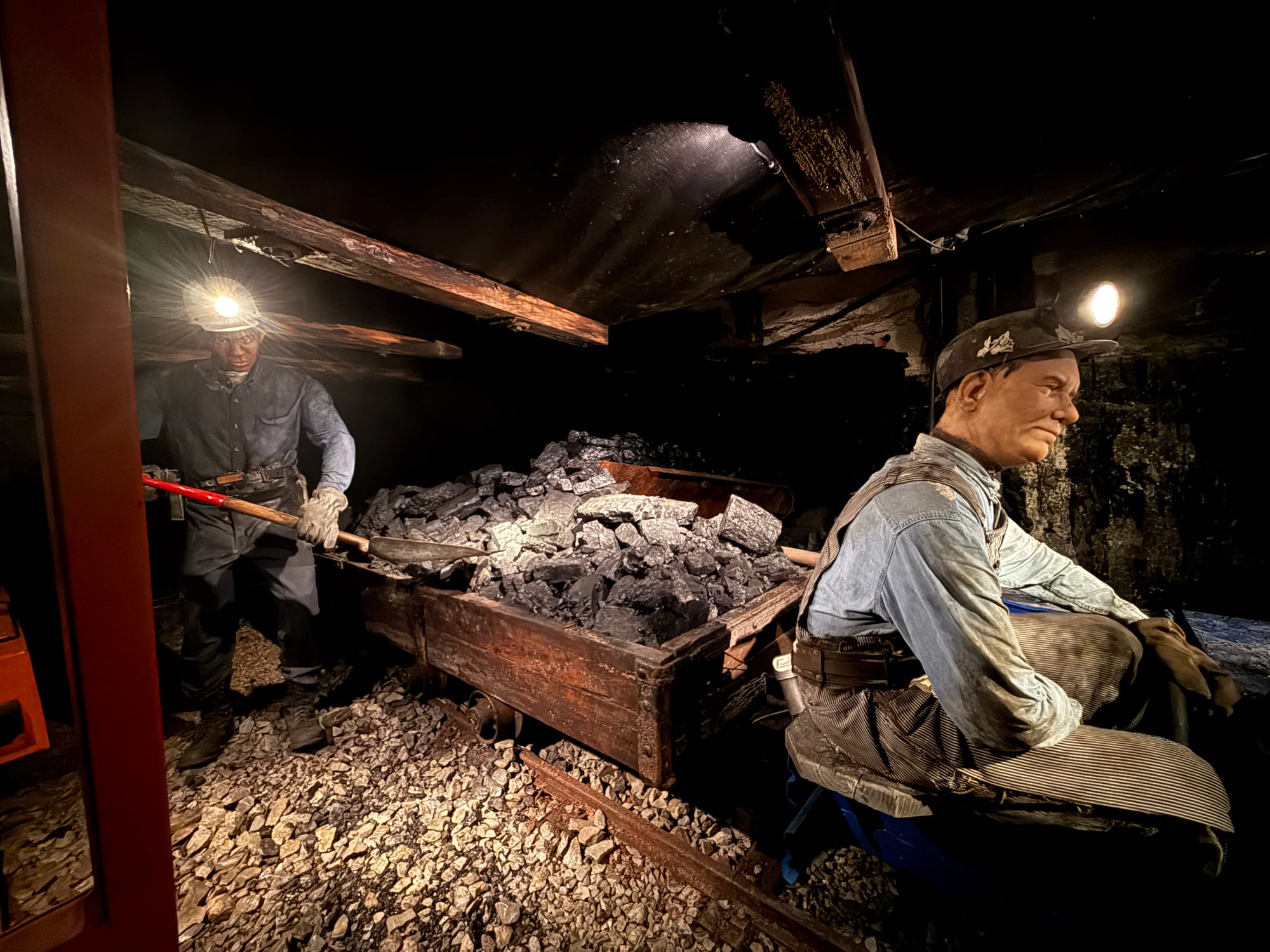
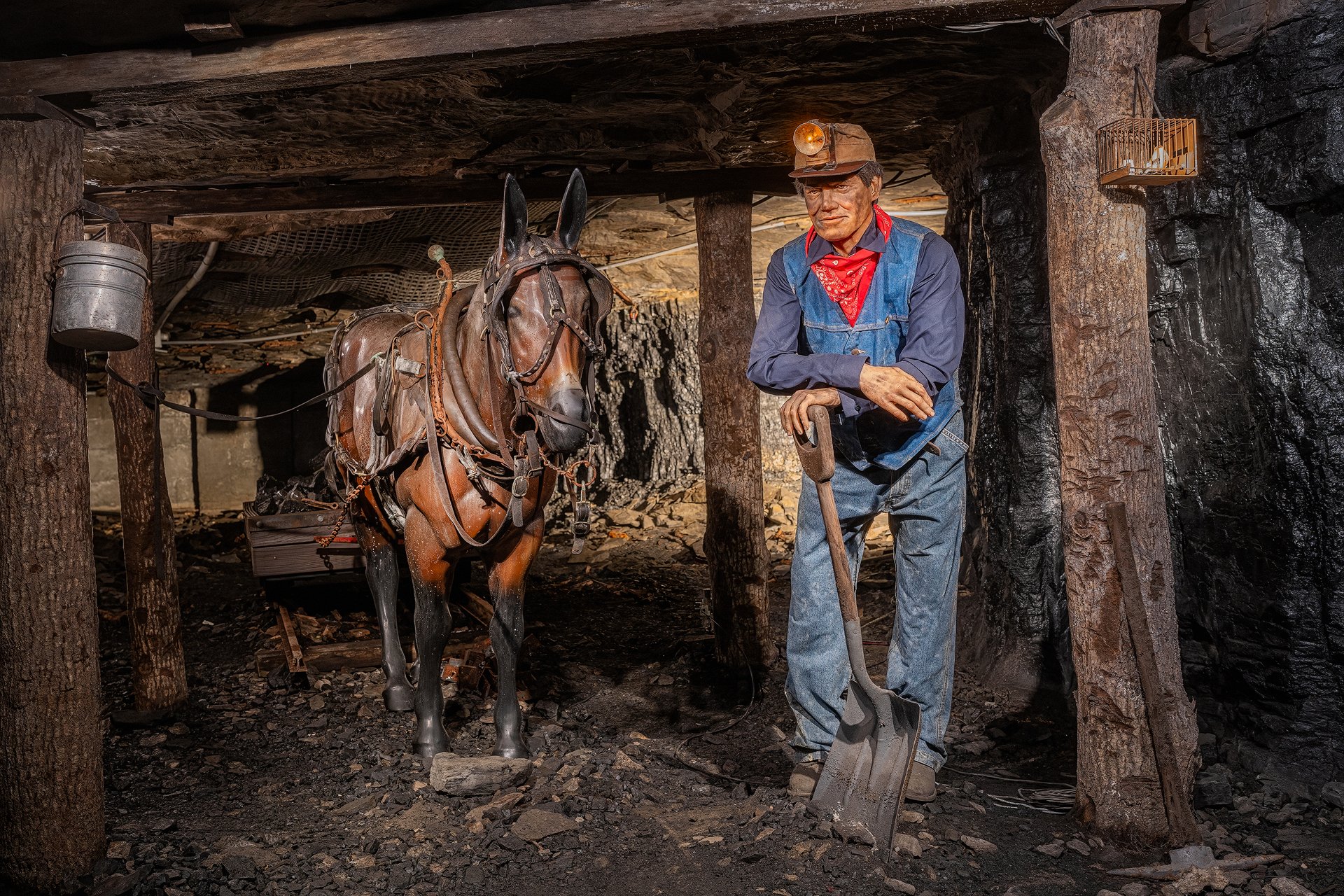
Later, another animatronic describes the new technology of roof bolts, which greatly improved safety by reducing the reliance on post-and-beam supports. (I was glad to know that, according to the narration, those roof bolts would hold for hundreds of years.) Another stop described how the mines were integrated workplaces—despite what happened above ground, people of different races worked side by side underground. The tour progressed from 1917 to the early 1960s, though the final stop went back millions of years and explained how coal came to be.
Driving through the darkness
We were often in pitch-black darkness moving from stop to stop along the tour. It is hard to describe just how dark it was in the mine, but try this: stand in a room in your home without any windows, turn out all the lights, and close your eyes for good measure. It was still darker than that. At the risk of sounding naïve, I just could not believe how dark it was.
I was, admittedly, startled by the appearance of one of the animatronics—I wasn't expecting it to be less than a foot away from where I was sitting, and it materialized out of the total darkness. An interview with the Portal 31 director I read afterward—thankfully—mentions that some attendees have seen ghostly apparitions of miners still at work and that being in the mine by himself has made him a believer in ghosts. On my visit, we were only joined by the living (as far as I know, of course).
Living in a company town
Lynch, like neighboring Benham, was a company town. The U.S. Coal & Coke Corporation laid out Lynch in 1917, not an elected mayor or city council. From the Portal 31 website:
While considered one of Appalachia's model coal camps due to its company provided health care, education, churches, housing, social services, recreation, wages and benefits, it was still a closed community where the company carefully controlled all aspects of the political and economic process. The company had their own police force which was also used to keep union organizers out of the coal camp and to intimidate miners who tried to join the union. Throughout the 1920s and well into the 1930s the company along with many Kentucky coal producers did everything in their power to prevent unionization. This action by the coal companies and the actions of the miners earned Harlan County the name of "Bloody Harlan."
The Merle Travis song Sixteen Tons describes life in these company towns—later recorded and popularized by Tennessee Ernie Ford with finger snaps and clarinet-led accompaniment. Workers lived in company-owned homes, shopped in company-owned stores, their children attended company-owned schools, and company security enforced the company's rules and prevented unionization. Employees bought their groceries, clothes, and supplies from company-owned stores, and the company took the balance due out of their check first. The system kept workers in perpetual, literal debt to their employers.
Coincidentally, my visit fell on the Friday of Labor Day weekend. Labor Day, in addition to marking the closing of pools and when white and seersucker go back in the closet until the following May, is the annual holiday recognizing workers' contribution to society—the 40-hour workweek, overtime pay, and the right to unionize. Along the way, corporate leaders opposed each of those things we take for granted today. Coal miners were horribly oppressed by their employers—their pay, for the longest time, was determined by the tons of coal they mined in a day, never mind the fact that they might have been in an area that just didn't have a coal seam to mine that day.
Another coal mine exhibit
Several months ago, I visited Chicago's Griffin Museum of Science and Industry. The group I was with wanted to go on the coal mining tour, so I obliged and bought a ticket (it wasn't included with regular admission). I was curious how they'd present coal mining and, more broadly, how they would portray areas where mining was prevalent. Would the Appalachian region be reflected accurately? Generally, yes—though I don't remember specifics of the tour. But I know I didn't leave feeling offended on behalf of my fellow Kentuckians.
The Griffin Museum's interpretation was interesting, sure. But something more profoundly touching was moving through the actual mine, where thousands of miners toiled day after day to remove millions of tons of coal from beneath the earth.
Black lung
Outside, there are monuments, one to John L. Lewis, a long-time president of the United Mine Workers, and another serving as a memorial to the miners who died in mining accidents. No official death toll exists for this mine in particular, though the monument honors some 200 who did not make it out alive. That doesn't, of course, include the unknown number who later succumbed to black lung disease, which as recently as 2018 was reported to be making a comeback. In the same 2018 article for the New York Times, an epidemiologist at the National Institute for Occupational Safety and Health was quoted as saying, "there’s an unacceptably large number of younger miners who have end-stage disease and the only choice is to get a lung transplant or wait it out and die." For the miners of 1917, there was no lung transplant option. They worked until they died.
Plan a visit
The site also features a 1920s lamphouse, bathhouse, L&N train depot, and loadout system. The Portal 31 mining complex was the largest in the world during its peak in the 1930s and 1940s. An RV park across the street has 12 RV spots and eight primitive sites.
I expected to enjoy the tour, but I did not expect to be as moved as I was. Moving along the cart path, I kept picturing those men and boys, some as young as eight years old, of years past toiling away in the dark, cold, wet, dangerous mine.
I highly suggest a visit and recommend making time to visit the shop afterward to see real artifacts from the mine's active days, including an original oil-powered headlamp.
 0
0